NVIDIA H100 vs A100 for LLM Training
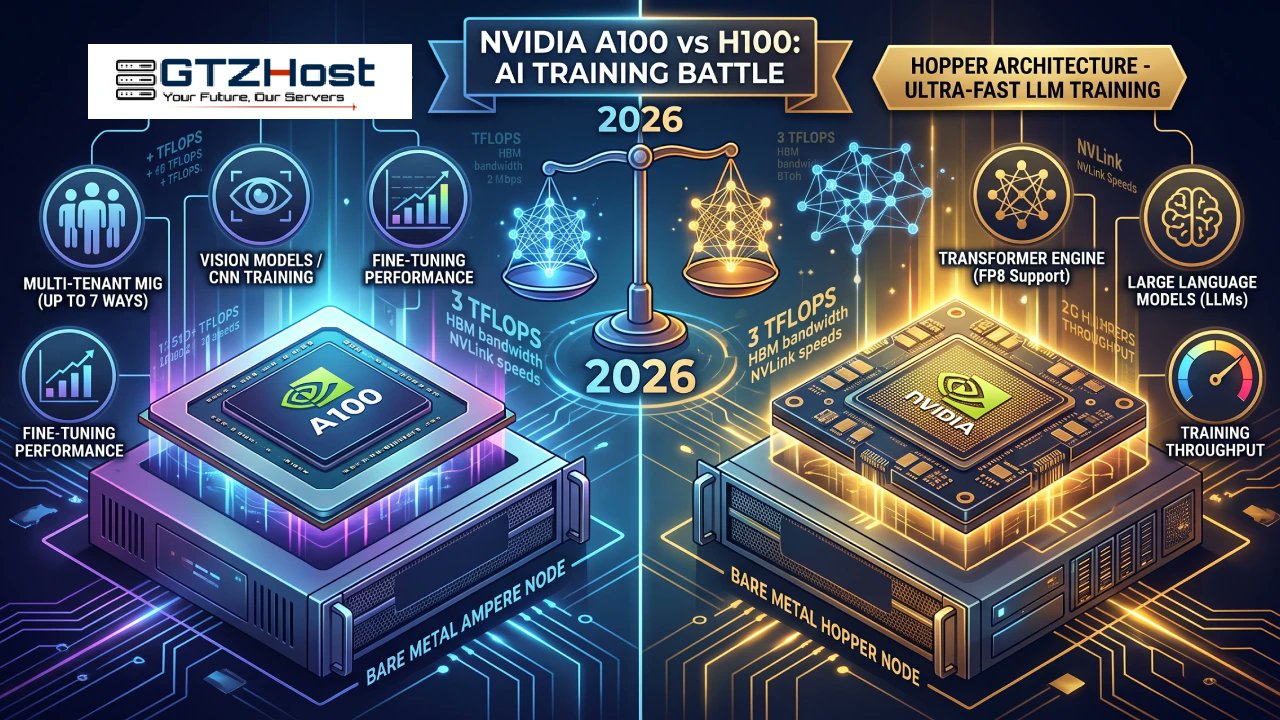
When provisioning high-performance computing clusters for Generative AI, systems engineers must evaluate the architectural trade-offs between NVIDIA's Ampere (A100) and Hopper (H100) microarchitectures.
Here is a technical breakdown of why the H100 dominates transformer workloads, and where the A100 remains highly relevant.
Precision and The Transformer Engine The H100 features a dedicated Transformer Engine capable of dynamically casting between FP8 and FP16 precisions. In transformer-based architectures, applying FP8 quantization to standard matrix multiplications yields massive throughput improvements without degrading model perplexity. The A100 is restricted to FP16/BF16/TF32 tensor operations, inherently capping its throughput on attention mechanisms.
Memory Subsystem (HBM2e vs HBM3) LLM inference and long-context pretraining are fundamentally memory-bound (memory bandwidth limits performance before compute limits do).
A100: Provides up to 80GB of HBM2e at 2.0 TB/s. H100: Provides 80GB of HBM3 at 3.35 TB/s. This 67% increase in bandwidth on the H100 minimizes the overhead of swapping KV-cache layers during generation and allows for significantly larger batch sizes during distributed data-parallel (DDP) training.
- NVLink and Interconnect Topology For multi-node distributed training using NCCL (e.g., Megatron-Turing NLG setups), interconnect bandwidth is the primary bottleneck. The H100 pushes NVLink bandwidth to 900 GB/s (vs 600 GB/s on the A100).
Deployment Note: To fully utilize these interconnects and eliminate host-to-device bottlenecks, workloads must be deployed on bare-metal gpu servers. Virtualized environments introduce hypervisor latency that degrades NCCL all-reduce operations during distributed training epochs.